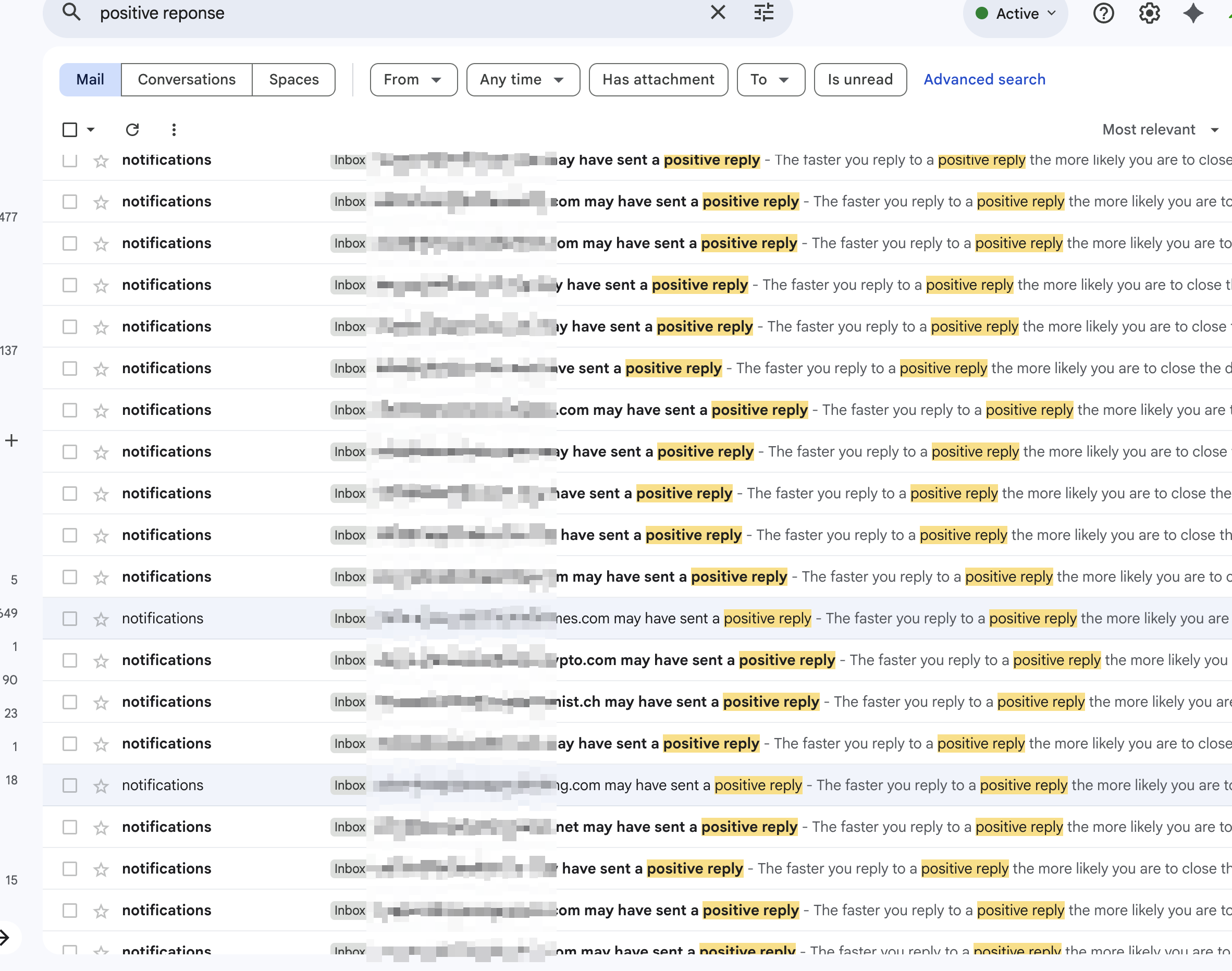
Anyone who’s run an outreach campaign knows the feeling: you spend hours crafting prospect lists, personalizing emails, and hitting send — only to watch your inbox stay frustratingly quiet.
Low response rates are the single biggest pain point in link building outreach. But how low is “low”? And more importantly, what separates the campaigns that get responses from the ones that get ignored?
We analyzed outreach patterns across thousands of campaigns and spoke with link building professionals to put together this snapshot of where blog outreach response rates stand in 2026 — and what’s actually moving the needle.
The Numbers: What Response Rates Look Like Today
Let’s start with the benchmarks most outreach teams are seeing.
Overall cold outreach response rates hover between 5% and 15% for well-executed campaigns. That means for every 100 emails sent, somewhere between 5 and 15 will generate any kind of reply — including “no thanks.”
Positive response rates (replies that express interest or lead to a placement) are lower, typically in the 3% to 8% range for cold outreach. The rest are polite declines, auto-replies, or requests for payment.
Follow-up emails significantly improve results. A single follow-up sent 5-7 days after the initial email can boost overall response rates by 40-60%. A second follow-up adds another 10-20%. Beyond two follow-ups, the returns diminish sharply and the risk of being marked as spam increases.
Warm outreach — contacting people you have an existing relationship with — sees response rates of 30% to 50% or higher. This is why relationship building is consistently cited as the most underrated aspect of link building.
How Response Rates Vary by Outreach Type
Not all outreach is created equal. The type of pitch you’re sending dramatically affects how likely you are to get a reply.
Guest Post Pitches: 8-15% Response Rate
Guest post pitches remain one of the better-performing outreach types, largely because the value exchange is clear: you provide free content, they get a ready-to-publish article. Blogs that actively accept guest contributions are already primed to say yes — the question is whether your pitch is relevant and your proposed topics are interesting.
The spread in response rates comes down to targeting. Pitching blogs that have published guest posts recently and cover topics you’re qualified to write about pushes you toward the higher end. Mass-emailing every site with a “write for us” page drops you to the bottom.
Resource/Link Insertion Requests: 3-8% Response Rate
Asking a blogger to add your link to an existing post is a harder sell. You’re asking them to edit published content for your benefit, which requires more trust and a clearer value proposition.
The requests that work tend to be very specific: “Your post on X mentions Y but doesn’t link to a resource for it — we have a comprehensive guide that could be helpful for your readers.” Generic “I noticed you wrote about X, here’s my link” emails perform poorly.
Broken Link Outreach: 10-18% Response Rate
Broken link building consistently outperforms other cold outreach methods because you’re solving a real problem. Nobody wants 404 errors on their site, and you’re offering a fix along with the notification.
The catch is that broken link building requires more upfront work — finding the broken links, verifying they haven’t been redirected, and ensuring your replacement content is genuinely comparable to what was originally linked.
Digital PR Pitches to Journalists: 3-5% Response Rate (But Higher Impact)
Pitching journalists is the lowest response rate category, but each successful placement is worth far more. Journalists at major publications receive hundreds of pitches daily, so standing out is genuinely difficult.
The pitches that break through tend to lead with a specific, surprising data point, are timed to a trending topic, are short (under 100 words before the data/details), and come from someone who has pitched that journalist relevant stories before.
What Drives Higher Response Rates
Across all outreach types, a handful of factors consistently separate high-performing campaigns from low-performing ones.
Personalization Depth
This is the single most impactful variable. “Hi [First Name], I love your blog” isn’t personalization. Referencing a specific article the person wrote, commenting on a point they made, or connecting your pitch to something unique about their site — that’s personalization.
Campaigns with genuine, specific personalization see response rates 2-3x higher than those using templates with mail-merge tokens.
The paradox is obvious: deep personalization takes more time per email, which limits volume. The most successful outreach teams solve this by investing more time in prospecting (so every email goes to a highly qualified recipient) and less time on scale.
Subject Line
Open rates dictate everything downstream. If your email doesn’t get opened, nothing else matters.
Subject lines that perform well for outreach tend to be short (under 50 characters), specific rather than vague, curiosity-driven without being clickbaity, and free of spam trigger words (“free,” “opportunity,” “partnership”).
A subject line like “Quick question about your [specific topic] post” consistently outperforms “Guest Post Opportunity” or “Collaboration Proposal.”
Timing and Day of Week
Tuesday through Thursday mornings continue to be the sweet spot for outreach emails. Monday inboxes are flooded with weekend backlog. Friday emails get buried before the weekend.
Sending between 9 AM and 11 AM in the recipient’s time zone tends to produce the best open rates. This means segmenting your send schedule by time zone if you’re doing outreach at scale.
Sender Reputation and History
Your email sender reputation affects whether your emails even reach the inbox. High bounce rates, spam complaints, and low engagement signal to email providers that your messages aren’t wanted.
Maintaining a clean list (verified emails only), warming up new email accounts gradually, and removing unresponsive contacts after 2-3 attempts all protect your sender reputation. Some outreach teams use dedicated domains for outreach to avoid any risk to their primary domain’s reputation.
The Offer
At the end of the day, response rates reflect whether you’re offering something the recipient actually wants. A blog owner who regularly publishes guest posts wants quality content. A journalist wants a compelling story. A webmaster with broken links wants them fixed.
Understanding what each segment of your prospect list values — and leading with that value in your pitch — is the most reliable way to improve response rates across the board.
The Trends Shaping Outreach in 2026
A few shifts are worth noting.
AI-generated outreach is creating more noise. The barrier to sending thousands of “personalized” emails has dropped to near zero, which means bloggers and journalists are drowning in outreach that sounds human but feels hollow. Ironically, this is making genuinely personal outreach more effective than ever — if you can stand out from the AI slop, you’re already ahead.
Bloggers are increasingly monetizing links. The percentage of responses that include a price for placement has been climbing steadily. This is particularly common in mid-tier blogs (DR 30-60). Higher-authority publications rarely charge for links because their editorial standards preclude it, and lower-authority blogs are often just happy to receive quality content.
Social-first outreach is gaining traction. Some link builders are finding better results by engaging with prospects on Twitter/X, LinkedIn, or even in blog comments before sending an email. The email then becomes a warm follow-up rather than a cold introduction, which significantly improves response rates.
Niche specificity matters more than ever. As outreach volume increases across the board, bloggers are becoming more selective. Pitches that demonstrate deep knowledge of the blog’s specific niche and audience are being rewarded with higher response rates, while generic “one-size-fits-all” pitches are being filtered more aggressively.
Improving Your Own Response Rates
If your campaigns are underperforming these benchmarks, here’s where to focus.
First, audit your prospect list. Are you emailing sites that are genuinely relevant to your content? Are the contact emails correct and up to date? Are the sites actively publishing? A clean, well-targeted list will do more for your response rates than any amount of email copywriting optimization.
Second, read your pitch out loud. Does it sound like something a real person would write to someone they respect? Or does it sound like a form letter with blanks filled in? If it’s the latter, rewrite it.
Third, follow up. A surprising number of outreach campaigns leave money on the table by not following up. One well-timed follow-up is not annoying — it’s expected. Many bloggers simply missed your first email.
Fourth, track everything. Response rate, positive response rate, placement rate, link quality. You can’t improve what you don’t measure. Over time, patterns will emerge — certain prospect types, pitch angles, or subject lines that consistently outperform — and you can double down on what works.
Key Takeaways
Blog outreach response rates in 2026 aren’t what they were five years ago. Inboxes are more crowded, bloggers are more skeptical, and the volume of AI-generated outreach has raised the noise floor considerably.
But the fundamentals haven’t changed. Relevant targeting, genuine personalization, clear value propositions, and consistent follow-up still produce results. The teams seeing response rates well above the median are the ones executing the basics at a higher level — not the ones searching for some secret hack.
If you’re building outreach campaigns at scale, investing in better prospect data and more efficient targeting is the highest-leverage improvement you can make. Every minute spent emailing the wrong person is a minute wasted.
Leave a Reply